📧 mithvin@gmail.com
📞+91 900 608 4701

📧 mithvin@gmail.com
📞+91 900 608 4701
Imagine that you have written the best article, but no one clicks it. Gone are the days when you felt like winning an Olympic medal when your website ranked top on Google’s first page.
You will observe that search has changed its shape dramatically in modern times. This shift has happened because the readers you target expect quick and personalized answers. AI is helping this shift to happen through platforms like Google AI Overview, Microsoft Copilot, Claude, and ChatGPT. Consequently, these platforms summarize the information and stop sending visitors to your site.
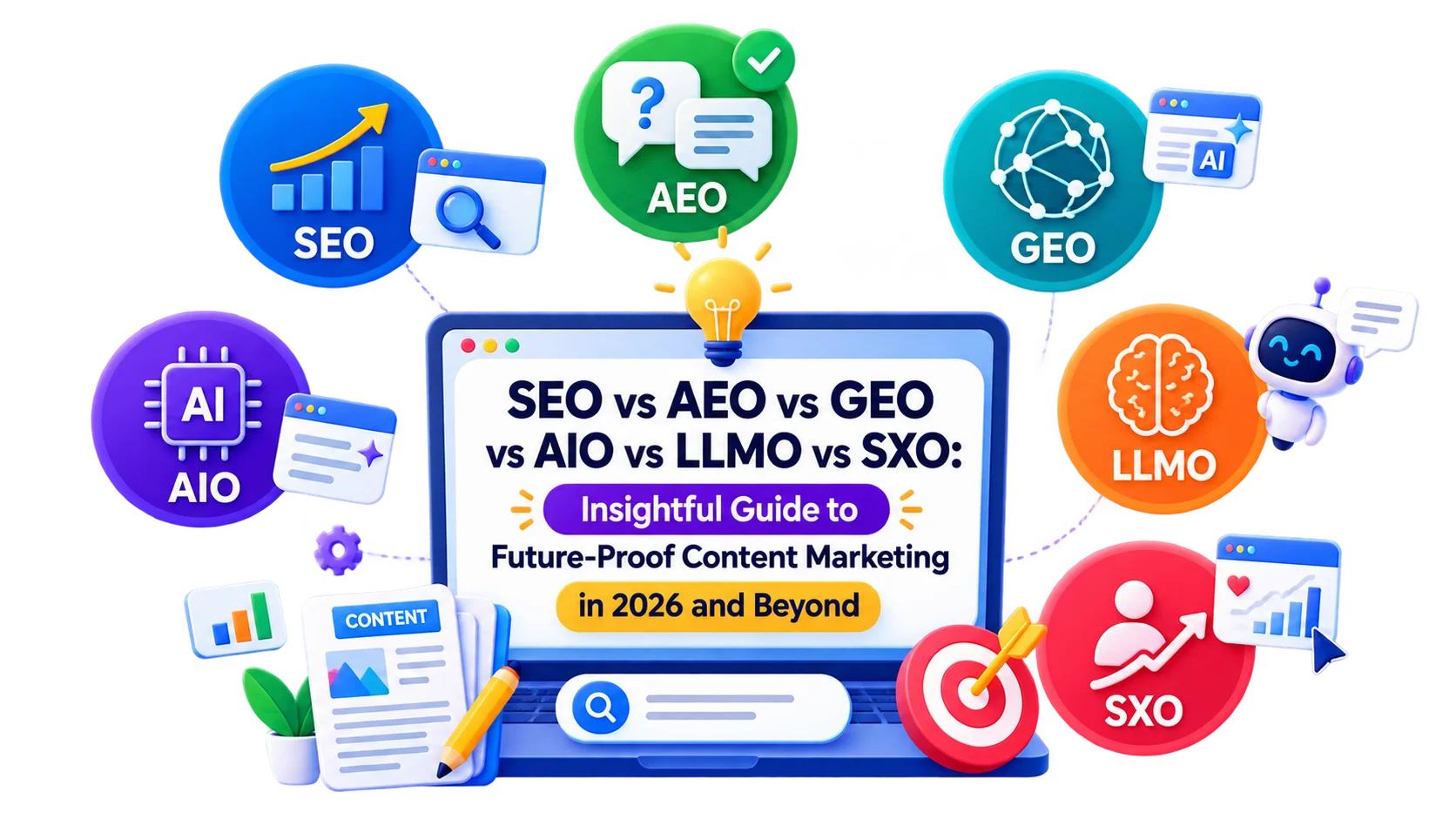
You should not get confused that SEO, AEO, GEO, AIO, LLMO, and SXO are different. Instead, there are 6 lenses on the exact same asset. In this article, you will get a deep insight into SEO vs AEO vs GEO and other mentioned terms, leading you to design a future-proof, AI-ready content strategy.
Full forms of SEO, AEO, GEO, AIO, LLMO, and SXO are as follows:
While SEO, AEO, GEO, AIO, LLMO, and SXO all focus on improving content performance and business visibility, each approach works differently.
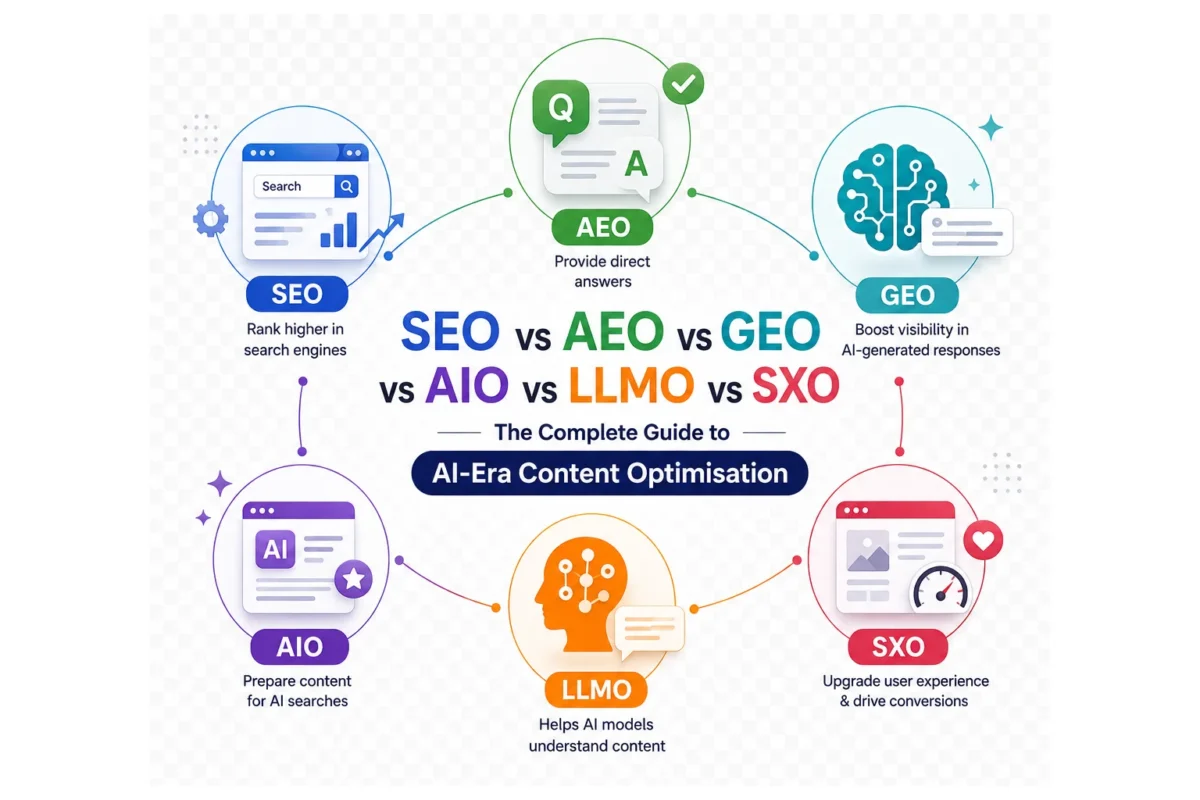
SEO focuses on search visibility, AEO focuses on direct answers, GEO and AIO focus on AI-powered search experiences, LLMO helps AI models understand content, and SXO improves the overall user experience. Let’s understand the differences in each optimization approach.
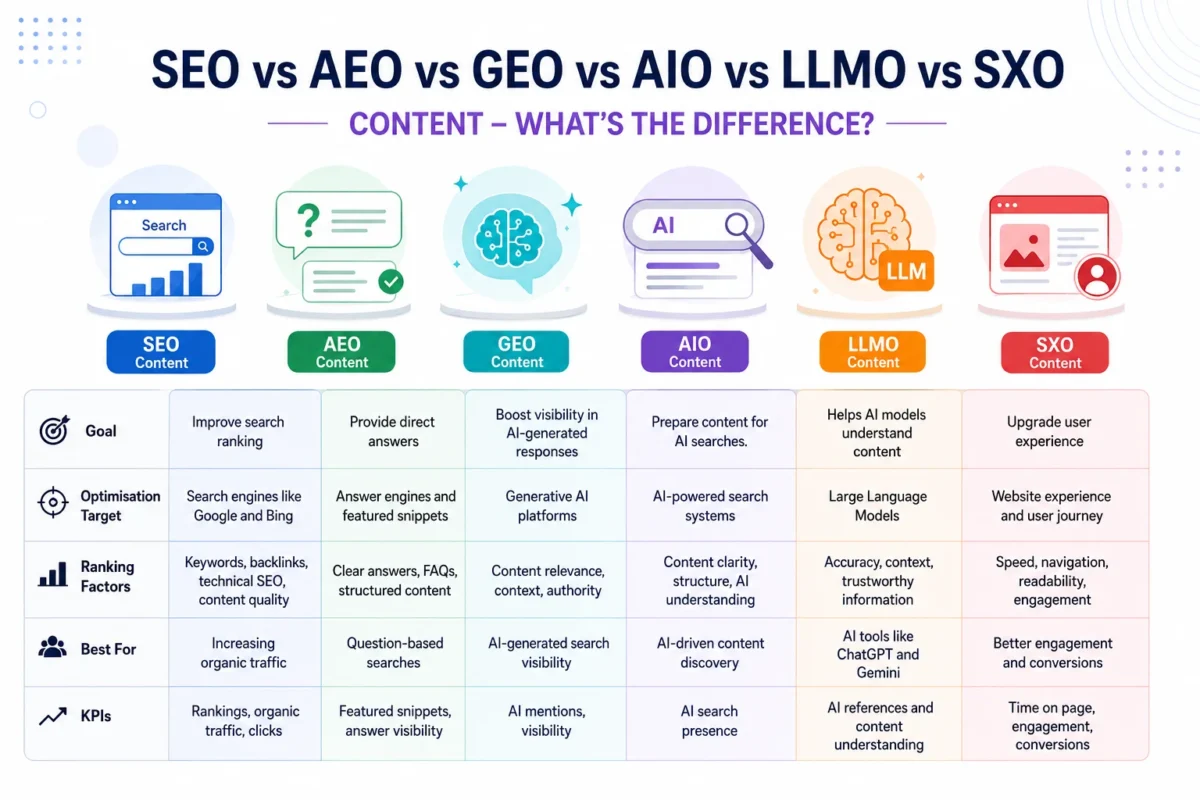
| Acronyms | SEO Content | AEO Content | GEO Content | AIO Content | LLMO Content | SXO Content |
| Goal | Improve search ranking | Provide direct answers | Boost visibility in AI-generated responses | Prepare content for AI searches. | Helps AI models understand content | Upgrade user experience |
| Optimisation Target | Search engines like Google and Bing | Answer engines and featured snippets | Generative AI platforms | AI-powered search systems | Large Language Models | Website experience and user journey |
| Ranking Factors | Keywords, backlinks, technical SEO, content quality | Clear answers, FAQs, structured content | Content relevance, context, authority | Content clarity, structure, AI understanding | Accuracy, context, trustworthy information | Speed, navigation, readability, engagement |
| Best For | Increasing organic traffic | Question-based searches | AI-generated search visibility | AI-driven content discovery | AI tools like ChatGPT and Gemini | Better engagement and conversions |
| KPIs | Rankings, organic traffic, clicks | Featured snippets, answer visibility | AI mentions, visibility | AI search presence | AI references and content understanding | Time on page, engagement, conversions |
But why do you need to take care of all these content optimization techniques? Will it affect your business if you do not take care of search engine, AI, and LLM-optimized content?
Well! Instead of giving a verdict here, let’s dive deeper to understand the changing search engine trend. And then you will understand the importance of optimizing your content for all these platforms, along with tips and core principles. At the end of this article, you will be able to make a smart decision for your content marketing strategy.
Audit it now with auto calculated scores based on 200+ parameters.
Today, you can find any information with just one click, but just imagine a world where no search engines exist. At that time, you had to know the exact web address to access the right content. Let us unfold the remarkable journey and make you understand how finding relevant content became simpler over time.
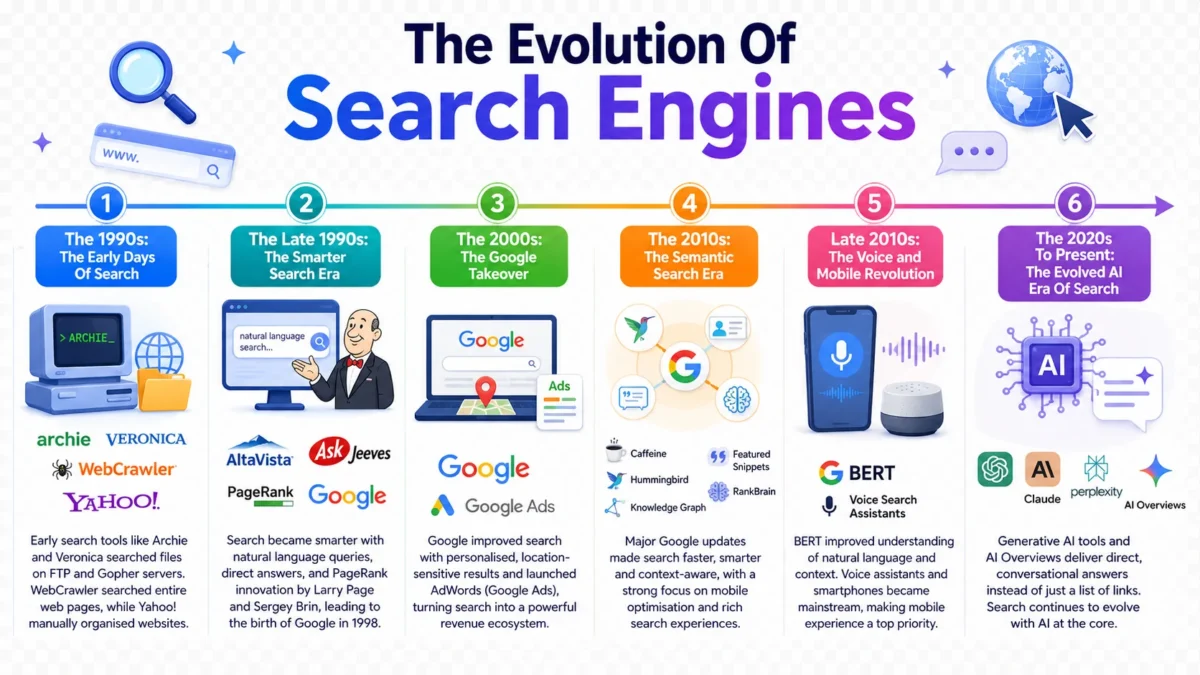
You will see that the first search engine, called Archie, was created in the year 1990. People used to keep files that could be downloaded from FTP servers. It used to search file names stored on these FTP servers, instead of searching web pages. Soon after, a related tool named Veronica searched for information on Gopher servers.
In 1994, WebCrawler became the first search engine to search for any word inside an entire web page, not just titles or URLs. At the same time, Yahoo! built a model where real people manually streamlined websites into folders.
You will observe that the search engine became more advanced during the late 1990s. The algorithms were advanced and delivered better results. AltaVista (now Yahoo Search) was established in 1995, where you could ask your questions using natural language instead of using search terms.
Also in 1996, Ask Jeeves (now known as Ask.com) was established, where your questions would be answered directly rather than giving you links. During that very year, two PhD scholars named Larry Page and Sergey Brin invented PageRank. This page was ranked by analyzing the links pointing to it. Consequently, two years later, in 1998, PageRank was named Google, and it changed the entire scenario of search engines in the world.
Google came into existence in 1998, but it gained dominance in the 2000s. Google was improving its search engine in such a way that it started delivering customized and location-sensitive results. The end result was that when two people searched for the same keyword, they got two different search pages.
Google launched its advertising platform known as AdWords (now Google Ads), which acted as the main source of its revenue generation. Companies paid for their visibility and turned static pages into a value-based ecosystem.
And then Google revolutionized search in 2009. It integrated live updates from social media and news sites, making static search pages feel alive.
Read more about what Google Advertising is.
Do you remember how search engines got smarter in the year 2010? Along with this, several Google updates like Caffeine, Hummingbird, Knowledge Graph, Feature Snippets, and RankBrain were launched. These were major Google search algorithms that gave faster and better results.
Proper real-time mobile optimization was also done during this era, making the search engine prioritize mobile-friendly experiences.
You should understand that Google’s BERT algorithm played a vital role during this era. It started helping Google to understand natural phrases and contexts better than before. Smartphones and voice assistants became more popular, giving priority to mobile-friendly websites in the late 2010s.
You must be aware that the advent of AI has changed the way people search online. Now, generative AI tools like ChatGPT, Claude, Perplexity, and Google’s own AI overviews return a direct result instead of listing sites. From Archie to artificial intelligence, the world has seen a dynamic evolution of search engines over decades.
You need to realize that multi-engine optimization, like AIO, SEO, LLMO, and more, matters to protect your website’s visibility and reduce your risk of vulnerability. Moreover, it will help you to unlock more traffic and revenue than focusing on a single search or AI engine.
Your optimization for many search engines shows you up on multiple platforms and AI engines. You will gain more chances to win clicks and sales.
You should spread your efforts across multiple channels to make sure that one algorithm update does not cut off your revenue and traffic. Consequently, you build resilience to fight ranking shifts and policy changes.
You must know that Google has the highest competition across the industry to show results at the top of the SERPs. Thus, diversifying your efforts into multiple search engines can enhance traffic sources and reduce dependency on single sources, thus providing better conversions.
When you optimize your content across different engines and AI models, you can compare performance in a better way. You don’t have to rely on single-engine data, which will improve your market understanding.
When you opt for multi-engine optimization, it becomes quite evident that you are positioning your brand to appear in both traditional searches and AI-generated answers. This future-proofs your visibility irrespective of the evolving technology.
Though search engines have evolved drastically over decades, the core principles remain the same. Human-focused writing, along with technical execution, is still there.
Thus, you need to understand the following core principles to provide valuable and helpful content even while focusing on GEO (Generative Engine Optimization), LLMO (Large Language Model Optimization), or other practices.
When you are designing content, you should take care of the visitors by keeping the page understandable. You should make sure that they have clarity on what the page is all about. This should be achieved by keeping your headings clear, paragraphs short, and language simple.
Apart from this, navigation, menus, and internal links should be kept simple to avoid the visitor’s bounce rate. In addition to that, you should avoid cluttered ads, video auto-play, and unwanted pop-up visibility on the page. Also, you should make your content multi-device-friendly.
Think about what the user needs before beginning your content. Do they need some information, a specific website, or a plan to purchase something?
If your content directly answers the user’s question, you provide the user and the search engines with a good experience.
Read more about On-page SEO content optimization techniques for ranking in detail.
There needs to be complete education of the reader on the topic so that they develop trust in your work through the detailed discussion of the topic, which will also be very useful in dealing with queries related to the topic.
The core principle that remained untouched also includes technical readiness as one of the important roots of valuable content. Technical SEO optimization includes on-page and UI/UX, which clearly indicates how easily and pleasantly a user can communicate with your web page.
Page speed, menu navigation, clear communication, and transparency in your content are also essential and stay static throughout the SEO-optimized content publishing journey.
Undoubtedly, AI has changed the way people search, but the basic SEO remains the same as years ago. AI recommends your content after it thoroughly understands it, and following traditional SEO helps your content be well organized and easy to understand. Simple and sorted content is much more likely to reach the right audience.
Traditional SEO still employs certain practices that stay untouched even after search engine evolution:
Along with the evolution of methods of searching for the needed data, the approaches to content optimization also started to change.
Earlier, companies used SEO techniques to raise the visibility of their content on the search engines. Nowadays, there are different methods of information gathering, such as AI overviews, ChatGPT, voice assistants, and other sources powered by artificial intelligence. This has led to the emergence of new methods of content optimization, such as SEO vs AEO vs GEO, as well as AIO, LLMO, and SXO, all focusing on different aspects of the modern search process.
The employment of artificial intelligence techniques allows companies to increase the visibility of their pages on search results and create an AI-powered strategy to increase their visibility, credibility, and relevance during the search process.
Now, it is crucial to understand how these techniques can be combined into an efficient approach to AI search optimization.
SEO (Search Engine Optimization) is the process of creating content in a way that helps your website appear in search engines when people search for relevant topics. Here, the goal isn’t just to rank higher; it is to create content in a way that the content seems valuable and helpful to the readers and matches their search intent.
The first step in creating successful SEO optimised content is understanding the purpose of the search, after which the focus changes to the natural use of keywords, headings, meta description, and title tag, along with internal linking. In addition, having a fast and mobile-friendly website is essential.
An effective SEO content strategy also involves the following:
Worth Reading: How to Optimize Website Content for SEO Ranking?
AEO (Answer Engine Optimization) is about crafting content that gives direct answers to the queries of the users. SEO-optimized content will get your content to show up in search engine results, but AEO will make your content the answer that people are searching for, because it’s in featured snippets, voice search, and AI-powered search responses.
An Answer Engine Optimization (AEO) strategy can only succeed if you first get to know the questions your target audience asks and answer them clearly and concisely.
The components of effective AEO-optimized content are:
Related Post: 10 SEO Content Optimization Tips to Improve SERP Ranking
Search behavior is shifting with the growth of AI-based search tools. Unlike displaying the websites found from a search query, ChatGPT, Gemini, and Google AI Overviews can provide a direct response by gathering and understanding data from multiple sources.
GEO (Generative Engine Optimization) focuses on creating content that has a better chance of being understood and used in these AI-generated responses.
The main difference between SEO vs GEO is the way content visibility is approached.
SEO focuses on improving rankings on traditional search engines, while generative engine optimization focuses on improving visibility in AI-generated search results.
Similar Post: Why Take Care Of SEO For Content Writing?
While regular SEO is mostly concerned with increasing visibility in search engines, AIO (AI Overview) is all about producing content that can meet the needs of the evolving use of AI in search. This involves producing information that is not only relevant to users but also structured in such a way that suits modern searches.
AIO content combines SEO strategies and AI strategies to enhance the performance of content marketing beyond the usual search engine rankings. It is defined by its clarity, relevance, and provision of comprehensive information.
Tips to optimize content for AIO
A strong AIO content approach helps businesses create AI-friendly content that supports AI citation and content optimization for LLMO searches.
LLMO (Large Language Model Optimization) is the process of creating content that AI tools like ChatGPT, Gemini, Claude, and Copilot can easily understand and use when answering user questions.
Thus, instead of focusing only on search rankings, LLM optimization focuses on making content clear, complete, and trustworthy so AI models can understand the topic without confusion.
With the increased popularity of using AI tools as a way of searching for information, there is also a need for content that will be able to answer questions in a clear and detailed manner.
Content writing for AI search engines needs to be written in simple language and also have a logical structure with correct information for AI models to be able to understand it easily. It will also ensure ChatGPT optimization with an increased chance of your content being recognized as a reliable source.
Tips to improve LLMO content optimization:
Search Experience Optimization (SXO) concentrates on the overall experience of the user once they click on your site.
Of course, the first thing is to bring the customer to your site using SEO, but if your site is slow, poorly navigated, or hard to read, they will leave right away. This is the reason why SXO (Search Experience Optimization) is an essential aspect of search experience optimization strategies used in the modern world.
A perfect blend of great content and a flawless website will enable users to get information and find other web pages without any hassle. Thus, your website must be high-speed, mobile-friendly, user-friendly, and have good, readable content.
Simply put, SEO enables your website to be found by users, while SXO makes a website that convinces people to stay, consider the brand, and convert into loyal buyers.
Read more about to Optimize Your On Page SEO Like a Pro
A lot of people talk about SEO vs AEO vs GEO, but these are not rivals. Every one of them has its own unique purpose.
For instance, SEO is useful in helping users find your content via Google, Bing, or other search engines, whereas answer engine optimization helps with providing answers to certain queries, and generative engine optimization does the same but provides AI-generated responses.
With the growth of AI-powered search, modern approaches like AIO and LLM optimization have become important.
On one side, AIO helps prepare content for AI-driven search experiences; on the other hand, LLMO helps AI models understand and use information effectively. At the same time, SXO is focused on enhancing the overall user experience, starting from finding your page to landing on the website and engaging over there. Together, these strategies form a full approach in which each optimization supports the others.
Here is how.
It is important for organizations not to compare SEO, AEO, GEO, AIO, LLMO, and SXO with one another but to realize that each of them fulfills a distinct purpose. Together, these strategies contribute to the development of more efficient content. Thus, focusing on one strong content discipline designed around the modern framework can diversify results for search engines, AI discovery, and humans.
See a sample of AI-optimized content.
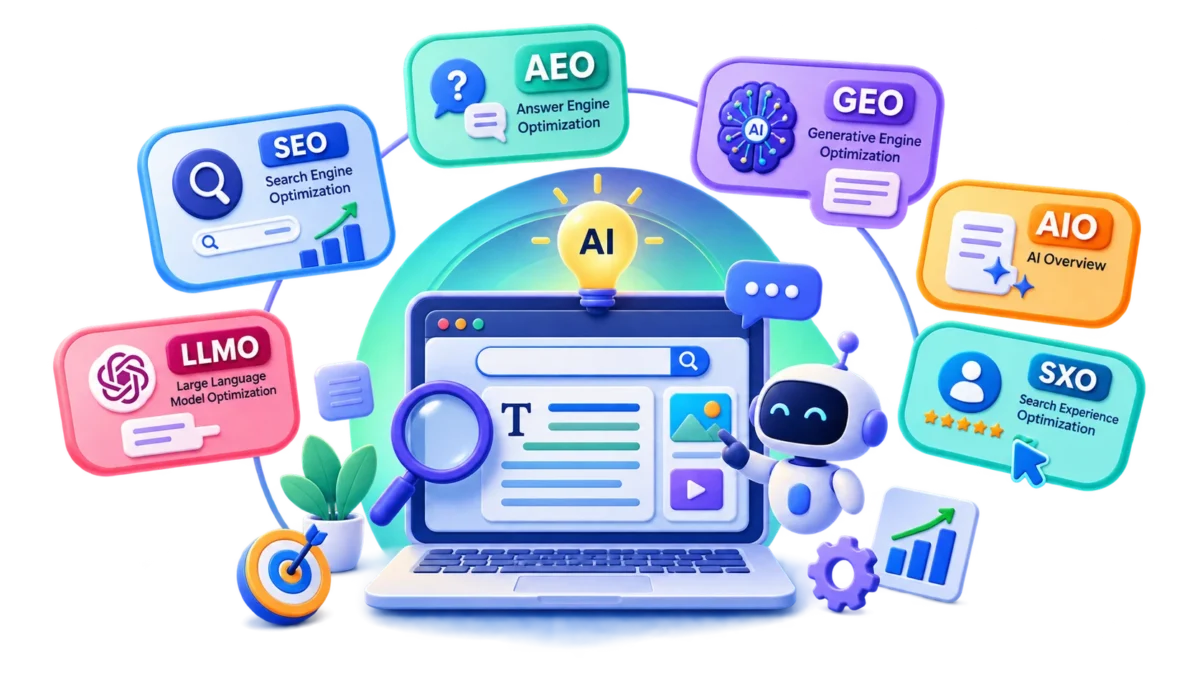
Suppose a subject matter expert at Mithvin is writing a guide on “How to Optimize a B2B SaaS Article for SEO, AEO, GEO, LLMO, and SXO.”
Here, instead of creating 6 different article versions for each of these optimization approaches, we can build one authoritative content asset and optimize different layers of the same guide.
Let’s see an example of how we will approach the content writing to meet the modern search trend.
| Optimization Strategy | Mithvin’s Approach For Future-Proof Content Optimization |
| SEO | We will target relevant keywords such as “B2B SaaS content strategy”, optimize the H1, headings, internal links, metadata, slug, and technical performance. |
| AEO | We will add question-based subtitles or a dedicated FAQ section to cover common queries such as “What is a B2B SaaS content strategy?”, “How to optimize SaaS content for AI citation,” etc. And then, we will answer each question immediately and clearly. |
| GEO | We will mention original insights, credible sources, and relevant samples so that GEO can focus on positioning content for AI-generated responses. |
| AIO | We will include definitions, examples, and comparisons to help AI systems get useful context when generating answers to relevant users’ queries. |
| LLMO | We will use consistent terminology, clear entities, concise explanations, structured sections, and factual supporting information. It will help evolving language models interpret the subject accurately. |
| SXO | We will improve content readability with short paragraphs, descriptive headings, tables, visuals, clear navigation, mobile usability, and strategically placed CTAs. |
| Conversion | We will complete the guide with a relevant CTA such as “Get a Free B2B SaaS Content Audit” instead of a generic “Contact Us.” |
Request industry-specific writing samples.
The short and clear answer is no – not necessary. However, modern AI content optimization doesn’t deal with only one particular search engine anymore. Your audience searches via search engines like Google, Bing, Baidu, and more; AI systems like ChatGPT, Gemini, Perplexity, and more; and answer engines like MS Copilot, AI Overview, and more. Thus, your content must be optimized enough to get cited and visible across all of them.
It is not that SEO, AEO, GEO, AIO, LLMO, and SXO replace one another; rather, they complement each other to form a more efficient AI-ready content strategy. They work together to offer a better user and AI experience and better visibility, clarity, and credibility of your content.
AI (artificial intelligence) tools are highly capable of helping you write content faster; however, that does not necessarily mean it will always be high quality. AI tools are able to produce the idea, structure the text, and write an article in no time.
However, it is still not capable of knowing your ideal target audience, your brand, your experience, and the in-depth details of your business as you do. And that’s exactly why a human touch is essential. After all, you better know what your audience is looking for, which examples will help explain your subject, and what data should be verified before being shared with your readers.
The most effective way of SXO optimized content creation is through the blend of AI abilities and human views. AI would be able to help in conducting research, coming up with ideas, and writing content. But only human writers would be able to know the ICP (ideal customer profile), verify the facts, provide examples, and simplify the content.
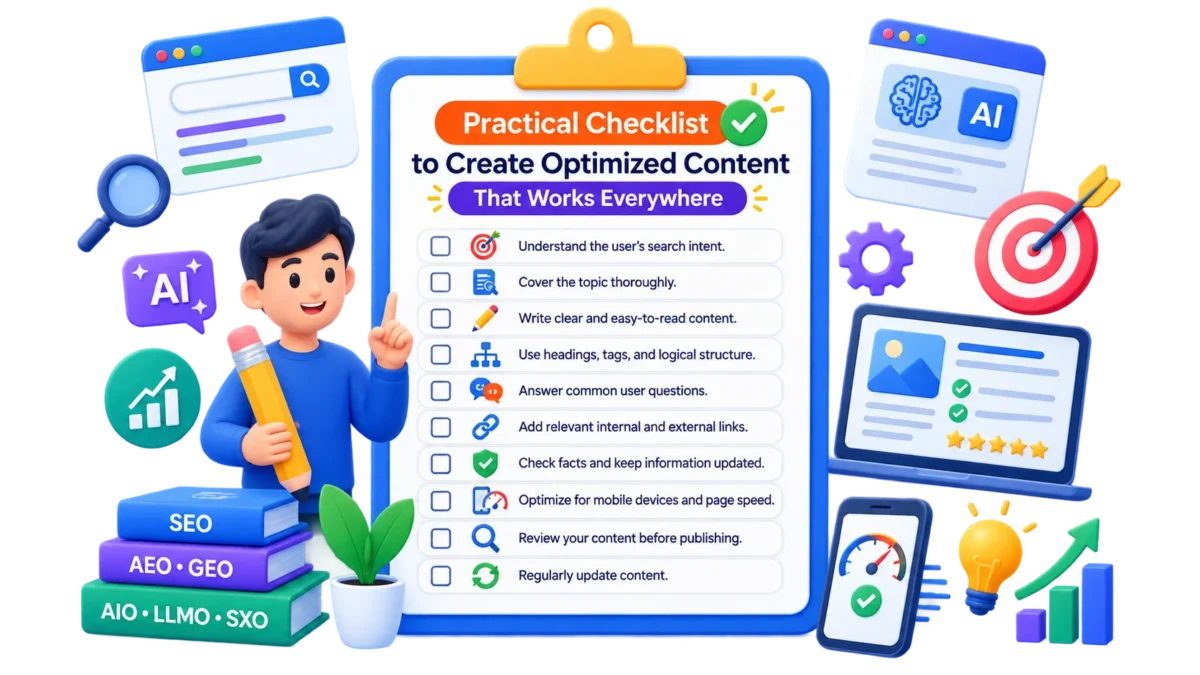
The key to effective AI content optimization does not lie in sticking to a particular approach. It is all about implementing an entire content optimization strategy, which can improve the performance of your website on search engines, AI platforms, and users’ experiences. Use the following checklist to ensure your content is ready to publish and sounds good enough to get cited by LLMs.
- Understand the user’s search intent.
- Cover the topic thoroughly.
- Write clear and easy-to-read content.
- Use headings, tags, and logical structure.
- Answer common user questions.
- Add relevant internal and external links.
- Check facts and keep information updated.
- Optimize for mobile devices and page speed.
- Review your content before publishing.
- Regularly update content.
Audit it now with auto calculated scores based on 200+ parameters.
Related Topic: Effective Blog Post Tips To Make Your Site Loved By Google
Every business has its own unique audience targeting, its own objectives, and its own challenges. That’s the reason why we never jump directly to creating a content writing strategy. At Mithvin, we don’t write for yesterday’s algorithms. We build interconnected, EEAT-driven digital trust systems.
Our content writing services integrate SEO, GEO, and SXO practices into every piece we deliver, ensuring your content connects with both human searchers and AI models alike.
For us, content goes beyond ranking high in search engines. Content should be understood, trusted, and useful to people. This is why our SEO, AEO, GEO, AIO, LLMO, and SXO strategy allows us to create great-performing content that can easily respond to the future of search while attracting qualified leads and sales to improve ROI.
Check out how we helped businesses with strategic content built for SERP, AI citation, and humans.
Taking care of an evolving content optimization approach is essential for SEO agencies, digital marketing companies, web development firms, and other B2B and B2C brands. However, attempting to handle all six different optimization methods (SEO vs AEO vs GEO vs AIO vs LLMO vs SXO) in-house can be a perfect recipe for burning out your team. It will simply lead to your marketing department being busy, focusing nowhere.
Thus, it is wise to choose a reliable partner who can take care of your content calendar with an expert team. Also, outsourcing content writing projects releases you from complex market research and algorithm understanding so that you can focus on other priority tasks to grow the website.
If you are in search of a reliable content agency nearby, Mithvin YRB would be the place to start a conversation. Unlike many content creation companies that often focus only on publishing, we create strategic content designed for real users as well as AI models.
Being a specialized content creation firm, we focus on creating valuable content that supports both search engines and AI-powered platforms. Our SEO content writing services combine GEO, LLMO, and SXO practices with AI search optimization to deliver human-led and AI-friendly content that helps businesses improve visibility and build long-term digital trust.
LLM content optimization refers to the development and improvement of content in a manner that makes it easier for AI-powered assistants to understand and use the provided information. This approach focuses on the creation of informative, useful, and structured content.
Creating well-researched, trustworthy, and useful content can help your website get cited by AI tools like OpenAI ChatGPT, Gemini, Perplexity, and more. The AI-optimized content should include clear answers and information supported by trusted sources, as well as stick to EEAT principles.
GEO (Generative Engine Optimization) content best practices include writing that answers questions completely, provides suitable context for topics, and delivers trustworthy information that AI platforms can interpret for GEO optimization.
When it comes to SXO (Search Experience Optimization) for content, ensure that you write your content in clear language. It must be easy to understand for the reader and cover the essence of the topic in the beginning itself. Also, the format of the content should be clear with proper headings, meta tags, bullet points, and short paragraphs. It will help users get insightful information without any difficulties.


Your AI Search Readiness Audit Checklist is ready.
> Click the button below to create your own Google Sheets copy.
> Google may ask you to sign in if you’re not already logged in.
> That copy will be saved directly to your Google Drive.